
| The Reichsbahn's first years (1919-1928) |
Before WW I the former German Reich consisted of many smaller kingdoms
and principalities. Most of them operated a state railway of their own,
the so-called Laenderbahnen. On January 1st 1919 the following state railways
existed:
|
|
The new Reichsverfassung (constitution of the German Reich) from August
11th 1919 laid down, that they all should be terminated and replaced by
a unique state railway company. Only the Bavarian state railways saved
a little bit of their independence, for example in ordering vehicles. This
company, founded in April 30th 1920 by a treaty between the seven state
railway companies, was first called Reichseisenbahnen (sometimes the date
is cited as April 1st 1920 as the treaty was dated back). |
There were two possible strategies:
|
| The result of the DRG's consideration was a mixed strategy: Firstly some of the state railways' recent developments were ordered, such as Prussian P 8 (DRG: class 38.10-40), Prussian P 10 (DRG: class 39), Bavarian S3/6 (DRG: 18.4-5), ... . This fact wasn't really new. The state railways of Prussia, Baden, Wurttemberg and Saxonia had already ordered locos of the Prussian class G12 (DRG: 58) during WW I. So G 12 might be called the first standard design loco and sometimes it is even called the war loco of WW I. |
| All in all several thousand locos constructed for the former state
railways were built until 1930 (!). The last locos were 18 531 - 18 536
and 18 538 - 18 540, delivered by Henschel in June 1930. Secondly the DRG started to develop a family of so-called standard design locos. The purpose was to get a family of classes, which had lots of identical parts (cylinders, axles, cabs, ...), often not only changeable between locos of the same class, but also between locos of similar classes. For example the classes 64, 86 and 24, all used for service on branch lines, were identical in many parts. The development of the new locomotive family was done by the "Engerer Lokomotiv Normen Ausschuß" (ELNA) but also by the Vereinheitlichungsbuero (VB, commission for standardisation, better: construction office), which was part of the Deutsche Lokomotivbau Vereinigung (DLV). Most locos of the first program were proposed to get a weight per axle of 20 tons, although most lines were not able to carry this weight. The first locomotive program from 1925 included the following locos of the 20 tons class: |
|
class |
wheel arrangement |
purpose |
remarks | |
|
20 to class: | ||||
|
2'C1' |
h2 |
express passenger trains |
was built | |
|
02 |
2'C1' |
h4v |
express passenger trains |
was built only for testing |
|
20 |
2'C |
h2 |
passenger trains |
never constructed |
|
22 |
1'D1' |
h2 |
passenger trains |
never constructed |
|
40 |
1'C |
h2 |
freight trains |
never constructed |
|
1'D |
h2 |
freight trains |
built as 1'D1' h2 | |
|
43 |
1'E |
h2 |
freight trains |
was built only for testing |
|
44 |
1'E |
h3 |
freight trains |
was built |
|
60 |
1'C1' |
h2 |
passenger trains |
never constructed |
|
62 |
2'C2' |
h2 |
(express) passenger trains |
was built |
|
82 |
1'D1' |
h2 |
freight trains |
never constructed |
|
83 |
E |
h2 |
freight trains |
never constructed |
|
84 |
1'E1' |
h2 |
freight trains |
built with 17.5 tons weight per axle |
| At least one fact is remarkable: Most of the planned locomotives have never been constructed. On the other hand lots of locos, which have actually been built later, were not included in the above program. This shows that the circumstances would change in the following years. Of course not every change in the program can be explained here. But is easy to see that the standard design loco programs were not made one time and never changed but something fluctuating. The first standard design locos which could be delivered to the DRG were 02 001 to 02 008 (1925 by Henschel), 02 009 and 02 010 (1926 by Maffei), 01 001 to 01 008 (1926 by Borsig) and 01 009 and 01 010 (1926 by AEG). Class 01 and 02 both were 2'C1' locos for express passenger trains, but 01 got two cylinders, working with superheated steam, while 02 got a h4v compound engine (the steam from the boiler is used twice before being exhausted. By high pressure (small) cylinders first, then by the lower pressure (larger) cylinders.). The purpose was to examine which type was working better. Of course it was well-known that compound locos work more efficient with high performance. On the other hand they are difficult to service - the inner cylinders cannot be easily reached. In the end the Reichsbahn decided to order the 2-cylinder 01. That was because most members of the committees were from Prussia, where compound locos weren't popular, and even Richard Paul Wagner, the 'Bauartdezernent' (something like chief engineer) of the Reichsbahn, could not be called a friend of compound locos. So compound locos have never been ordered again. The situation concerning classes 43 and 44 was similar. While 43 was a 2 cylinder loco (superheated steam), 44 got a three cylinder superheated steam engine. First it seemed that 43 would do better, but then it was obvious that the three cylinder engine was more suitable for heavy duties and more flexible. That settled it. After 35 locos of class 43 had been built, it was not ordered any longer and class 44 took its place. From now on the share of standard design locos was continually increasing (see figure 1). |
| Figure 1. Increasing share of standard design locos |
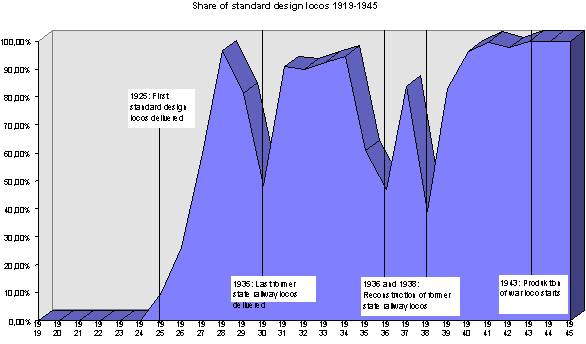 |
| Data source: Scharf, Hans-Wolfgang; Wenzel, Hansjuergen: Lokomotiven fuer die Reichsbahn, Freiburg 1996 |
| The following classes of standard design locos was produced until 1928: |
|
BR |
wheel arrangem. |
produced from ... to ... |
maximum speed (km/h) |
performance (h.p.) |
maximum weight per axle (mp) |
total number |
remarks | |||
|
Express passenger trains | ||||||||||
|
2'C1'h2
|
1925-1937 |
130 |
2240 |
20,2 |
231 |
|||||
|
02 |
2'C1'h4v
|
1925 |
130 |
2300 |
20,2 |
10 |
1) | |||
|
Passenger trains | ||||||||||
|
24 |
1'Ch2
|
1926-1938 |
90 |
920 |
15,1 |
95 |
||||
|
Freight trains | ||||||||||
|
43 |
1'Eh2
|
1927/28 |
70 |
1880 |
19,3 |
35 |
2) | |||
|
44 |
1'Eh3
|
1926-1945 |
80 |
1910 |
19,3 |
about 2000 |
||||
|
Passenger trains (tender locos) | ||||||||||
|
62 |
2'C2'h2
|
1928/29 |
100 |
1680 |
20,3 |
15 |
||||
|
64 |
1'C1'h2
|
1928-1940 |
90 |
950 |
15,3 |
520 |
||||
|
Freight trains (tender locos) | ||||||||||
|
Ch2
|
1927/28 |
45 |
575 |
18,2 |
39 |
3) | ||||
|
81 |
Dh2
|
1928 |
45 |
860 |
17,0 |
10 |
3) | |||
|
86 |
1'D1'h2
|
1928-1943 |
70 |
1030 |
15,6 |
774 |
||||
|
87 |
Eh2
|
1927/28 |
45 |
940 |
17,4 |
16 |
4) | |||
| 1) Only for testing against class 01. 2) Replaced by class 44. 3) For shunting. 4) Special edition for service at Hamburg harbour with extremely small radii of curves. Outer axles driven by Luttermoeller drive. |
| Back |